No, the T3•R can only be connected to TVs with HDMI.
In order to meet EU energy regulations, loop out is disabled in standby in order to conserve energy. It can be turned on in the System section of the Settings menu. Press HOME on your T3•R remote and go to: Settings > System > Loop Out in Standby.
Please see p18 of the Get Started Guide for more information.
There are a few possible reasons.
Your T3•R is not connected properly
Ensure your aerial is connected to your T3•R and an HDMI cable is connected from your T3•R to your TV.
When your T3•R is turned on, the LED on the front is blue.
The correct input on your TV is not selected
With your T3•R turned on and connected to your TV by HDMI, press the GUIDE button on your T3•R's remote control. This displays the TV Guide, making it easy to tell when you find the right input.
To change inputs, most TV remotes use a button labelled ‘AV’, ‘SOURCE’, ‘INPUT’, or with a TV icon and arrow. Each press should cycle through your inputs. Check your TV's manual if necessary.
Once you find the input displaying the T3•R's TV Guide, press EXIT on your T3•R's remote and check if live TV is working. Try changing to BBC One by pressing '1' on the remote control. If the T3•R says there is No Signal, you may have a problem with your aerial. To retune, press HOME and go to: Settings > Channels > Retune.
An incompatible HDMI resolution has been selected
If you are using HDMI, the T3•R may be set to an HDMI resolution that your TV does not support:
- Normally the T3•R is set to auto detect the HDMI resolution but this can fail with some TVs.
- The T3•R can also be manually set to a resolution in the Picture & Sound section of the Settings menu. This could cause an issue if you set a resolution (e.g. 2160p), then move the T3•R to another TV that doesn't support that resolution.
The T3•R can automatically cycle through common resolutions until you find one that works:
- Turn the T3•R on and wait 30 seconds.
- Press HOME.
- Press & Hold ‘0’ for 5 seconds.
- The T3•R will try each of the 3 HD resolutions for 15 seconds in this order: 1080p, 1080i and 720p. Select ‘Confirm’ when you can see the picture.
It is likely that the signal from your TV aerial is weak. Indoor aerials are particularly poor and extremely sensitive to direction, meaning they will often tune some channels when placed in one position and a whole different set when placed in another. If you have an outdoor aerial, it may not be aligned correctly to receive signals from your local transmitter.
If you've moved your T3•R to a new location (e.g. you've moved house), you must retune by pressing HOME and selecting: Settings > Channels > Retune > Full Retune.
HD channels are broadcast with Dolby Digital audio. If you cannot hear any sound on HD channels, it is likely that your TV does not support Dolby Digital but Surround Sound is selected in the Picture & Sound section of the Settings menu. Change the 'Audio Output' setting to 'Stereo PCM' to resolve the issue.
Your PIN can be reset using the master PIN. In order to protect minors, we don't publish the master PIN, so please contact us and we will give it to you.
Once you have the master PIN, go to the PIN section of the Settings menu and choose the 'Change PIN' option. When it asks for your PIN, enter the Master PIN and then follow the instructions to create a new one.
The T3•R has a power-saving feature called 'Auto Standby' that takes place after three hours when no buttons have been pressed on the remote control or front panel. The duration can be changed or Auto Standby can be turned off altogether by pressing HOME and going to: Settings > System > Auto Standby
They may have been programmed to control the volume of another device. You can reset your T3•R remote by following the instructions in ‘Reset Your Remote’ on page 21 of the Get Started Guide.
If you see the message "Volume controls are disabled for channels with Dolby Digital audio", this happens because HD channels are broadcast with Dolby Digital audio and the T3•R is passing through the audio unaltered as required by Dolby. Dolby's expectation is that the volume be adjusted on the final output device – i.e. your TV or AV receiver.
If you want to adjust the volume on your T3•R, change 'Audio Output' in the Picture & Sound section of the Settings menu to 'Stereo PCM'. The T3-R will the decode the Dolby Digital audio and output stereo audio instead.
You did not set the T3•R’s volume to max before programming your Manhattan remote to control your TV. To fix this:
- Reset your Manhattan remote by holding the S/AD and RED buttons for 3 seconds until the LED blinks
- Turn the volume up to max on your T3•R with the V-UP button
- Reprogram your Manhattan remote to control your TV (see page 21 of the Get Started Guide)
Apps require a minimum broadband speed of 3Mbps to stream video reliably. Even if you have a faster connection, e.g. 16Mbps, other devices may be using it at the same time and reducing the speed available to the T3•R.
If you are using Wi-Fi, you can check your Wi-Fi signal by pressing HOME and selecting: Settings > Internet
Even if the signal is good, it is still dependent on your broadband speed being fast enough. Also, too many other devices may be using your Wi-Fi at the same time and/or large downloads may be taking place, for example if your computer is performing a software update.
If your Wi-Fi signal is poor, try adjusting the location of your Wi-Fi router and/or its antenna(s). You can also try moving the T3•R itself. Alternatively, instead of using Wi-Fi, connect your T3•R to your internet router with an Ethernet cable.
Press HOME to show the Home screen then UP to highlight the Settings Cog icon and OK to select it.
When recording on two channels you can watch and pause or rewind a third channel. The available channels will depend on the two that are recording. If they are:
- on the same multiplex then you can watch any channel
- on two different multiplexes then you can watch any channel that's also on one of these two multiplexes
A multiplex is a group of channels that are broadcast together. For example, all of the main HD channels (BBC One HD, ITV HD, Channel 4 HD, Channel 5 HD, etc) are on the 'BBC B' multiplex.
Put simply, the T3-R will let you watch a third channel whenever possible and tell you if you need to stop a recording to do so. You can also turn on a setting to mark unavailable channels with a yellow triangle in the TV Guide and Channel Browser by going to: Settings > Channels > Mark Unavailable Channels.
The T3-R normally starts and stops recording when the broadcaster signals that the programme starts and ends. This is because programmes almost never start or end at the exact scheduled time – they're usually a minute or two early or late, and sometimes even more. This broadcaster signalling is normally very accurate and means recordings start and stop exactly when they should. However, sometimes broadcasters get it wrong, particularly on the more niche channels.
If you’re finding that some of your recordings are starting late or finishing early, we’ve added the option to change from this automatic behaviour and instead add a customisable amount of padding to the start and end of all recordings. Go to: Settings > Recording & Playback > Padding Options > Padding Type > Manual. In our testing we’ve found that 5 minutes of padding is plenty so have set this as the default to be added to the start and end, however you can change this to any amount from 2 to 10 minutes.
It’s important to note that if you have two consecutive recordings on the same channel then the padding between them will be ignored – the first recording will end at the scheduled time and the next recording will start at the scheduled time. The same applies if you have two consecutive recordings on different channels and a recording on another channel that overlaps both of these recordings.
As broadcasters usually signal the start and end of recordings correctly, it gets really annoying having to fast forward through the padding to the actual start of the recording. So, to avoid this, by default when you start playing a recording it will start from the signalled start rather than the recorded start. If for some reason the broadcaster signalled the start late, you can simply rewind back to catch the beginning . You can change this behaviour so that recordings always start from the recorded start by going to: Settings > Recording & Playback > Padding Options > Playback Start.
We’ve also added markers to the playback bar for where the broadcaster signalled the start and end of the recording:
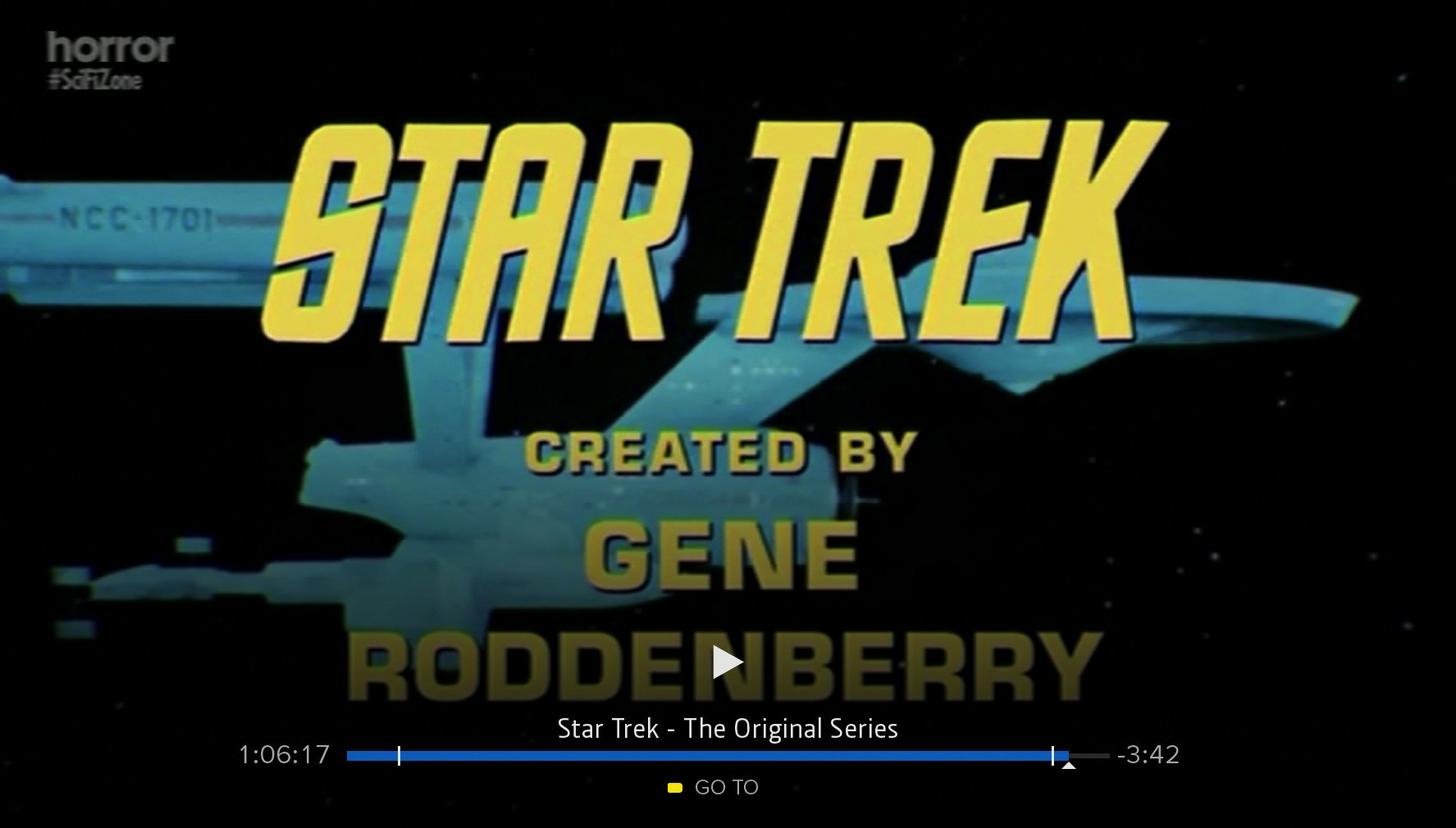
In this screenshot Star Trek has been recorded on Horror with 5 minutes of start and end padding. The white markers on the playback bar indicate when Horror signalled the start and end of the programme and in this case they signalled the end just over a minute early. If this had been recorded without any padding then the last minute would have been missed! But, because of the new padding feature the whole episode was caught, meaning you never miss a second of your favourite show.
Please note that broadcasters usually signal the start of programmes when they actually start but the end of programmes after the ad break that follows the end. So even if you don’t see the marker for the end of the programme, it doesn’t necessarily mean that the end of the programme was missed.
To make turning your TV on and off as easy as possible, when you turn on your T3-R it can turn on your TV and change it to the right input. Your T3-R will also go to standby when you put your TV in standby. This all works with AVRs and soundbars too.
Please note that some older devices may not support HDMI Control, and the feature needs to be enabled on your TV, AVR or soundbar to work. HDMI-CEC is the generic name but manufacturers all call it something different: Anynet+ (Samsung), Viera Link (Panasonic), LG (Simplink), BRAVIA Link and BRAVIA Sync (Sony), Aquos Link (Sharp). We just call it HDMI Control!
To enable this feature on your T3-R, go to: Settings > System > HDMI Options > HDMI Control.
When HDMI Control is enabled, the T3-R also has a setting to ‘Turn Off Devices’. Turn this on and when you press the standby button on your T3-R remote it will also put your TV and any other connected and compatible devices in standby too!
v2.07 Software Update
Released 11/06/25
This update ensures your T3•R continues to work with the latest versions of the ITVX and U apps, following recent changes made by the broadcasters. We've also resolved subtitle issues that occurred when catching up to live TV while playing back recordings that were still in progress.
Changes
Resolved
- ITVX and U could crash when starting playback of content due to recent app-side changes. (Please note that both apps temporarily reverted these changes until this update was available.)
- When playing back a recording that was still in progress, subtitles would stop working after fast forwarding and catching up to live TV.
- When playing back an in-progress recording while two other recordings were happening simultaneously, the wrong programme's subtitles would be displayed after fast forwarding and catching up to live TV.
How to Update
Check your software version
Press HOME and then select: Settings → Information. If the version shown is lower than 2.06, you can update.
Update your T3•R over the internet
- Your T3•R needs to be connected to your internet router by Wi-Fi or Ethernet cable
- Your T3•R will update automatically overnight while in standby (unless automatic updates are disabled in System Settings)
- A 'Software Updated' message will appear when you first turn on your T3•R after the update
- To update now, go to: Home → Settings → System → Software Updates → Check for Update Now
- To check your internet connection, go to: Home → Settings → Internet
Update using a USB Stick
You can update using a USB stick.
- Download the update files: Manhattan_T3-R_v2.07.zip
- Download the instructions: Manhattan_T3-R_v2.07_USB_Update_Guide.pdf
- On most computers you should be able to double click on the zip file to extract or browse the contents.
- Before proceeding, please read the instructions.
- Do not copy the zip file to your USB stick as that will not work.
Previous Updates
v2.06 Software Update
Released 06/08/24
This update resolves app issues, improves the visibility of programme information and on-screen elements, removes the discontinued BritBox from the Home Screen, and more.
If your T3-R is connected to the internet and left in standby, it will update automatically overnight, unless you have disabled automatic updates in the System Settings menu. Please see below for more information about updating, including how to update by USB.
Changes
Resolved
- A black screen could sometimes appear for 20-25s before apps or on-demand content would successfully open from Manhattan menus.
- Repeatedly switching and closing/opening BBC iPlayer, "U," or BBC HbbTV services could cause a memory leak, leading to system instability.
- ITVX issues:
- Playback of ITVX content sometimes failed, displaying a “something went wrong” message.
- The parental controls options for “Off” and “On” were truncated and not fully visible.
- The “News” category appeared empty, preventing content browsing.
- S4C issues:
- Signing in on the web did not provide the pairing code.
- Pause and resume functions were not working correctly.
- BritBox has been discontinued, and the app has been removed from the Home Screen. Customers who wish to continue using BritBox should access it through ITVX.
- When playing recorded content and using the Left button on the D-Pad to skip back, playback could unexpectedly jump back to the initial starting point.
Improved
- Programme icons (e.g., Subtitles and HD icons) and attributes (e.g., programme start and end times) have been changed from blue to off-white for better visibility.
- The background of Manhattan menus has been enhanced to provide better contrast with other on-screen elements, such as buttons and programme cells.
- The Home Screen “Connect” banner shown when the T3•R is not connected to the internet has been updated.
v2.05 Software Update
Released 23/05/23
This update introduces support for ITVX, allows for finer adjustment of lip-sync, and resolves issues from v2.04.
New
- ITVX is supported and will be accessible from the Home Screen from Thursday 25th May 2023.
Improved
- Lip-sync can now be adjusted in 10ms increments (previously 20ms).
Resolved
- When browsing backwards in the TV Guide for catch-up content, the T3-R could reboot when using the P-UP/P-DOWN buttons or entering channel numbers with the number buttons.
- When playing an ongoing recording immediately after using an interactive service like Channelbox (channel 271), if you fast forwarded to the live point and then tried to pause or rewind live TV, the error message 'This function is unavailable with interactive services' would be shown incorrectly.
- When playing an ongoing recording and fast forwarding to the live point, the playback position was not saved.
- When a recording was stopped, deleted and then started again, the new recording would show in the Trash.
- When playing an ongoing recording immediately after viewing a channel from a different multiplex, fast forwarding to live, rewinding, and then fast forwarding back to live would result in the loss of audio/video.
- When a series episode was broadcast simultaneously on two or more channels, it could be recorded on a different channel than the one originally scheduled for the recording.
- When a recording was scheduled on a channel but an alternative broadcast was recorded on a different channel, a second entry stating the recording had failed could be found in the Recordings menu
- When rewinding recorded radio programmes, playback would jump back to the point before you started rewinding.
- When Auto Standby was disabled and the T3-R was left on overnight on a channel with broadcasting breaks like Blaze (channel 64), recordings on that channel could fail.
- When playing back a recording and fast forwarding or rewinding, the audio/video could freeze.
- When recording continuously for 2 or more days, repeated programmes could be recorded again.
- When recording continuously for 2 or more days, the T3-R could become unresponsive while audio/video continued.
- When creating a child profile in BBC iPlayer, the T3-R would reboot when entering the month in their date of birth.
- When resuming HDR content in iPlayer, the TV could fail to switch to HDR.
- When HDMI-CEC was enabled, some TVs could wake up unexpectedly.
v2.04 Software Update
Released 24/06/21
This update resolves issues identified with recordings, HDMI Control, Wi-Fi and more.
Improved
- When content in an app (e.g. ITV Hub) was regionally restricted the error message made it sound like there was a problem with the app or T3-R. The message now clearly states it is the content that is unavailable.
- The serial number is now shown in the About section of the Information menu.
- Subtitles would not be shown if the broadcaster did not signal them correctly.
Resolved
- When the T3-R made a Wi-Fi connection and there were multiple access points or a previous Wi-Fi access point had been reset and configured with the same SSID the system could reboot.
- The hard drive could fail to initialise causing recordings to fail and recording-related features not to work.
- When fast forwarding or rewinding a recording, playback could unexpectedly jump to the start or end.
- When recording a series, the system could unnecessarily re-record an episode or create a duplicate recording of 0 seconds in length.
- When padding was set to Automatic, various issues could cause recordings to fail to start or end or to start or end late.
- When padding was set to Manual and a series recording was stopped during the start padding, if you tried to start the recording again it would fail.
- When padding was set to Manual and a recording started, if the Guide information had not yet been retrieved the recording would be saved with only the channel name, date and time the recording started.
- When padding was set to Manual a recording could fail to start if it was triggered before the hard drive was initialised.
- The system could sometimes crash when a second recording started and the recording conflict prompt was shown.
- When recording both series and split events (e.g. movies) on the same service, the system could re-use the same booking ID causing:
- The series recording to disappear from the Schedule (but episodes in the next 8 days to continue showing the series recording icon in the Guide)
- Episodes in that series to fail to record “due to power loss”
- The split event would record but there would also be duplicate entries that showed as failed to record “due to power loss”
- When first turning on the T3-R from standby and going to the Recordings menu the recordings sections could appear empty until exiting and re-entering the menu.
- After deleting a recording that was recorded from the live pause buffer, if there were any subsequent recordings made from the same service and live pause buffer trying to play them would result in playback jumping straight to the end and showing the “End of Playback” message.
- When deleting large recordings (e.g. longer than 2 hours in HD) the system could fail to clear the space properly and this would cause the free space to be calculated incorrectly and old recordings to be removed unnecessarily. Please note that after updating to 2.04 the system will automatically correct this and available free space may change.
- Recordings could be randomly deleted when there were more than 253 folders.
- The T3-R could fail to turn on from standby and the standby LED would remain red.
- When using an Ethernet connection, occasionally after booting and the last viewed channel was a BBC channel, the BBC Red Button+ service would fail to load until the channel was changed.
- When HDMI Control was turned on, the T3-R could force its input to become active when selecting a different input on the TV.
- When HDMI Control was turned on and the T3-R entered networked standby (sleep), e.g. during overnight housekeeping, problematic TVs that send unnecessary HDMI connect and disconnect notifications could cause the T3-R to wake the TV.
- The ‘Watched’ status of recordings would fail to be set when a recording was played to the very end.
- The resume point for a recording would fail to be set if the standby button was pressed during playback.
- When Audio Description was enabled the main audio could be unexpectedly low before the AD started.
- Audio Description could become active even when the setting was off.
- The Audio Description mix level could fail to work.
- When recordings were made from the live pause buffer subtitles would only work for the first recording. This has been retrospectively resolved so subtitles will work for all recordings.
- Live pause would not work after very quickly invoking the Channel Banner following channel change (changing the channel again would resolve the issue).
- ITV Hub could fail to open when playing deep-linked on demand ITV programmes, e.g. from the TV Guide.
v2.00 Software Update
Released 08/12/20
This is a major update that brings BritBox, HDMI-CEC support, customisable padding, 3rd channel viewing/timeshifting and many other improvements and fixes to the T3-R. Check out our blog post to learn about the major new features. Or if you're not sure what BritBox has to offer, you can find out more here.
New
- BritBox has arrived! Launch it from the Home Screen.
- Manual padding: Instead of relying on broadcaster signalling to start and stop recordings you can now add a customisable amount of padding to the start and end of all recordings. Go to: Settings > Recording & Playback > Padding Options. By default playback of recordings made with padding will start from the broadcaster’s signalled start but you can change this to the recorded start.
- HDMI-CEC support: when you turn on your T3-R it can now turn on your TV and change it to the right input and go to standby when you put your TV in standby. You can also choose to put your TV and any other connected devices in standby when your T3-R goes to standby. Go to: Settings > System > HDMI Options.
- 3rd channel viewing and timeshifting: when recording on two channels you can now watch a 3rd channel. The available channels will depend on the two that are recording. If they are:
- on the same multiplex then you can watch any channel
- on two different multiplexes then you can watch any channel that's also on one of these two multiplexes
- Flexible reminders: While two recordings are in progress, reminders can be set for programmes on (available) third channels. Overlapping reminders can also now be set, e.g. a programme at 12:00 – 12:30, another at 12:05 – 12:30, another at 12:15 – 12:45, etc.
Improved
- If a software update is detected during first time install, you no longer have to enter your Wi-Fi password again after the update has been performed.
- When pressing the S/AD button, the availability of Subtitles and Audio Description status is now shown based on the broadcaster’s signalling instead of the PMT. This can still be inaccurate if the broadcaster signals incorrectly, but in our testing it is more accurate than the PMT.
- Fast forward and rewind speeds are more accurate.
Resolved
- The T3-R could fail to turn on from standby and the LED would remain red.
- The T3-R could fail to record programmes and state that it was due to no signal even though the signal was ok.
- The T3-R could wake unexpectedly overnight.
- The T3-R could turn on from Sleep with no AV.
- After pressing the TEXT button on BBC channels when the internet was connected the system could stop responding to the directional or number buttons until the channel was changed.
- Audio Description could show as on but need to be turned off and on to work.
- The T3-R would show ‘No Signal’ for channels after performing a Smart Retune if the delivery system of their multiplex had changed.
- When adding a child profile to iPlayer, the T3-R would crash after entering the month of birth.
- When chase playing an active recording, the T3-R could stop playback and display “End of Playback” when the next programme started.
- In Wi-Fi networks with multiple access points, the T3-R would not always connect to the access point with the strongest signal
- While watching a live programme on a channel (e.g. BBC One HD) in full screen TV and using the Channel Browser to select a live programme on another channel (e.g. ITV HD) to record, the programme on the channel being watched (e.g. BBC One HD) would be recorded instead.
- The ‘G’ Guidance icon would be incorrectly shown instead of the ‘W’ Watershed icon.
- The BBC Red Button+ and green button restart service would not work after exiting playback of a recording to a BBC channel. Changing the channel or waiting for the next programme to start would resolve it.
v1.08 Software Update
Released 22/07/20
Resolved
- An issue introduced in 1.07 affecting A/V decoding that could cause the T3•R to restart unexpectedly, in particular when using ITV Hub.
- After the T3•R had been on for more than 48 hours the internet could stop working until you went to the Internet Settings menu or restarted the T3•R.
- The T3•R could be unexpectedly found on in the morning (we’ve resolved one issue but are aware that there is another still causing it for some customers).
- When playing back a recording or in live pause, subtitles could sometimes fail to turn on or take up to 30s to turn on.
- The system could incorrectly delete old recordings even though free space was available.
v1.07 Software Update
Released 10/06/20
Improved
- SD picture quality
- The T3•R will ignore retune events for transmitters that it cannot receive or are not currently tuned.
- The latest networking libraries have been integrated for improved network performance and reliability (e.g. in a Carrier Grade NAT environment).
- When playing a recording or in live pause, subtitles could take up to 30s to show after turning on
- The T3•R will wait for the Hard Drive to be unmounted before restarting, going to sleep or standby.
Resolved
- After viewing Programme Info using the INFO button, the TV Guide could become less responsive until the next restart.
- Audio Description could become out of sync and the volume of the main audio could dip unexpectedly.
- The incorrect regional channels could be chosen when the T3•R receives signals from multiple regions.
- When using surround sound speakers audio and the T3•R was set to output surround sound, audio could be heard for HD programmes with 2.0 audio from only the left and right speakers. HD programmes are broadcast with either AAC 2.0 or 5.1, both of which the T3-R transcodes to Dolby Digital. For more info, please see the BBC’s blog post here.
- Playback of a recording could unexpectedly exit to live TV following a dynamic change in the broadcast of a programme being recorded.
- The video could freeze during playback of a recording or in live pause.
- After watching a recording of a live programme (chase playback) to the end, when next using live pause, it could freeze and then fail to respond until a restart.
- Playback of a recording could stop immediately after starting.
- Freeview Play apps (BBC iPlayer, ITV Hub, etc) could sometimes not be listed on the Home Screen.
- When playing on demand content that was launched directly from a Manhattan menu (e.g. Featured or Search), the T3•R could crash after pressing BACK.
- A blank screen could be shown at the end of playback in ITV Hub (the system still responded to BACK to return to the ITV Hub menu or EXIT to return to the Manhattan menu).
- When using an ITV Hub+ account, playback of videos could fail
- Programmes on ITV channels with Audio Description would not show the AD icon.
- Playback in All4 could fail when Audio Description was enabled
- Deleted programmes that had been emptied from the Trash could be shown as recorded in the Guide and Channel Banner meaning that they could not be re-recorded.
- When pressing ® for the Record Options of a programme on now in the Channel Banner, the incorrect options would be shown.
v1.06 Software Update
Released 15/11/19
The following changes are since v1.04. Please note that v1.05 was not released publicly.
Resolved
- A recent change to My5 would crash the T3•R after selecting an option in its cookie prompt.
- Following (normally temporary) EDID failure during the HDMI handshake the T3•R’s Audio Output would change to Auto. This primarily affected Audio Receivers and Soundbars.
- Recordings could become misfiled when the database is restored from a backup. This can no longer happen and the recording list can be rebuilt if it has happened.
- The T3•R would detect a major retune event and prompt you to retune, but sometimes after retuning the retune status would not be cleared, prompting you to retune again.
- When using the Wi-Fi interface and DHCP IP address acquisition failed the T3•R would not retry, causing the T3•R to fail to detect an internet connection.
Improved
- When using interactive services that use legacy MHEG-IC technology (e.g. Planet Knowledge, Sports Network, Vision TV, etc) and video is playing back you can now use all Manhattan menus (e.g. TV Guide, Home, etc).
- Added a “Parental Controls” option to the “Recording & Playback” section of Settings. Turning it on requires your PIN to play recorded programmes not suitable for viewing before the 9pm Watershed to be played back before 9pm.
- During Install the instructions for re-entering your PIN to confirm it have been improved as some customers reported they were not sure what they had to do.
v1.04 Software Update
Released 09/10/19
The following changes are since v1.02 (the original launch release). Please note that v1.03 was not released publicly.
Improved
- The TV Guide has been optimised for faster navigation and presentation of programme information and icons.
- Memory management for media playback has been optimised to ensure responsiveness when seeking/skipping.
- Persistent channel lists: After selecting a list in the TV Guide (e.g. Favourites or HD Channels), as long as the channel being viewed is on that list when you re-enter the TV Guide, the list will continue to be selected. Changing to a channel not on the list or pressing Standby will reset the list back to All Channels.
- The Go To prompt can now be shown at any time when playing back a recording by pressing the yellow button. Previously the Playback Banner showing the hint to press the yellow button had to be on-screen.
- The Guide to Icons and Program Your Remote sections have been updated in the Help menu.
- When a programme is being recorded, the playback bar in the recordings menu now shows your viewing progress as a percentage of the estimated total programme length and not the current recording length.
- The Subtitle and Audio Description menu can be closed by pressing the S/AD button.
- The system can now be restarted in the System Settings menu and by pressing: Red - 0 - Red - Standby.
- The T3•R’s hostname has been changed to the product name to make it easier to identify on a network.
- The system will re-request app icons (e.g. iPlayer) if there is an issue receiving them on the first request.
Resolved
- After live pause, subtitles could go out of sync.
- The Hard Drive could fail to mount after waking up from sleep.
- Sky News video could be cropped incorrectly.
- When connecting the T3•R to a 4K AV Receiver or Soundbar that is in turn connected to a 1080p TV, after the T3•R woke from sleep no Audio/Video would be seen and the AV Receiver would display an error message stating it needed to be connected to an HDMI input on the TV that supports HDCP 2.2.
- When playing back a recording, Audio Description could fail to turn on and off correctly.
- When trying to set a recording that clashed with two other recordings, one of which was the second part of a split event, the system would fail to present the Recording Clash prompt and the event could not be booked.
- When switching between interactive Freeview channels (e.g. 74 Jewellery Maker) they could fail to load partially or fully.
- In the Guide, after holding the RIGHT button on the remote control to scroll fast through time, the focus would incorrectly be on the programme 1 hour after the time that had been scrolled to.
- Pausing a programme in My5 for an extended period of a few minutes or more could cause playback to fail to resume after pressing Play.
- When receiving signal from (a) multiple transmitters in a region with different regional depth levels and (b) one or more transmitters in another region, the system could fail to respect the regional selection made by the user during Install or a Retune.
- Recordings on dual data/TV channels (e.g. BBC Four) that only broadcast for part of the day could fail and cause no signal and further failed recordings until a restart.
- Retrieving thumbnails in the Recordings menu could cause a crash.
- While the very first recording made on the T3•R was in progress, the HDD space in the Recordings menu could be indicated as 0%.
- When the Hard Drive space allocated for recordings was full and the system had been in live pause for more than 2 hours, instead of removing the oldest unkept recordings as expected the system would report that the Hard Drive was full and recordings would fail.

Get Started Guide
Important Information Booklet (500GB)